

Old Town Heritage Conservation District Plan
The Heritage Conservation District Plan has been developed and includes: a Statement of Cultural Heritage Value, a Statement of Objectives, properties identified in the Study as contributing and non-contributing, and Statements of Contribution for each contributing property.
Read the Old Town Niagara-on-the-Lake Heritage Conservation District Plan dated February 2026 from the Town's consultants - Cultural Spaces.
Review the HCD By-law 2026-015 passed by Council on March 24, 2026
Council of the Town of Niagara-on-the-Lake previously passed By-law 2026-009 on February 24, 2026 to designate a portion of Old Town as a Heritage Conservation District and to adopt the Old Town Heritage Conservation District Plan under Section 41 and 41.1 of the Ontario Heritage Act.
Subsequently, it was identified that Schedule “B” (the District Plan) was not included in the final version of By-law 2026-009. To ensure the completeness and accuracy of the By-law, Council, on March 24, 2026, passed By-law 2026-016 to repeal By-law 2026-009.
On March 24, 2026, Town Council passed By-law 2026-015 to designate a portion of Old Town as a Heritage Conservation District and to adopt the Old Town Heritage Conservation District Plan under Section 41 and 41.1 of the Ontario Heritage Act. By-law 2026-015 includes all required schedules and reflects Council’s original intent. Pursuant to the provisions of Sections (41) and (41.1) of the Ontario Heritage Act.
About the Project
- Image

The Town of Niagara-on-the-Lake is a vibrant, growing community defined by its cultural heritage, agricultural setting and location at the mouth of the Niagara River. Niagara-on-the-Lake contains five urban areas, each with its own unique heritage character.
The “Old Town” urban area contains the Town’s only Heritage Conservation District, the “Queen-Picton (Old Town) Heritage Conservation District” (the “Queen-Picton (Old Town) HCD” or “HCD”), designated under Part V of the Ontario Heritage Act in 1986 (by-law 1667-86, approved by the Ontario Municipal Board in February of 1987, updated through By-law 4362-10).
Heritage Conservation Districts recognize the collective heritage value of an area or neighbourhood that has common elements or themes. Through designation under Part V of the Ontario Heritage Act, municipalities can identify and preserve these areas with unique heritage character through guidelines for managing future development and alteration of existing heritage structures. The Queen-Picton (Old Town) HCD is recognized for its collection of residential and commercial buildings that were constructed as early as 1815, the rebuilding period after the former Town of “Niagara” was burned in 1813.
The Queen-Picton (Old Town) Heritage Conservation District (“HCD”) was enacted in 1986 to protect the commercial core of Niagara-on-the-Lake’s Old Town area (“Old Town”).
As early as 1990, the Town of Niagara-on-the-Lake (“Town”) revisited ways to protect, preserve, and celebrate Old Town with proposed policy updates and studies aimed at updating the HCD Plan.
Updating the HCD Plan and considering an expansion of the HCD was identified as a priority through the Town’s Planning for Progress initiative (2021).
The Town has awarded the contract for the Queen-Picton (Old Town) Heritage Conservation District Study (the “HCD Study”) to Cultural Spaces, an Ottawa-based heritage consultancy firm.
Cultural Spaces is a multidisciplinary and bilingual team of specialists in heritage, sustainable development, and planning. They prepared the following description of their firm, which highlights the breadth of their work, expertise, and ethos as heritage consultants:
"We are a firm that combines heritage conservation and sustainable development strategies. We help manage change to preserve what matters. We combine expertise in heritage planning, urban planning, historical research, and architectural analyses. "
More information about the Cultural Spaces team can be found on their website: www.culturalspaces.ca.
- Queen-Picton Heritage Conservation District Plan Status Update, CDS-25-188
- Heritage Conservation District Study – Information and Status Update, CDS-24-131
- Heritage Conservation District Study Volunteer Group – Summary of Findings and Next Steps, CDS-24-164
- Queen-Picton Heritage Conservation District Study – Phase 1 Update, CDS-24-190
- Queen-Picton Heritage Conservation District Study – Study Area By-law, CDS-25-028
- Queen-Picton Heritage Conservation District Study – Revised Study Area By-law, CDS-25-043
- Queen-Picton Heritage Conservation District Study - Phase 1 Study Report, CDS-25-083
- Heritage Conservation District Draft Plan - CDS-26-002
Project Phases & Timeline
The project is currently in the Implementation Phase. Information about the project timeline will be updated on this page.
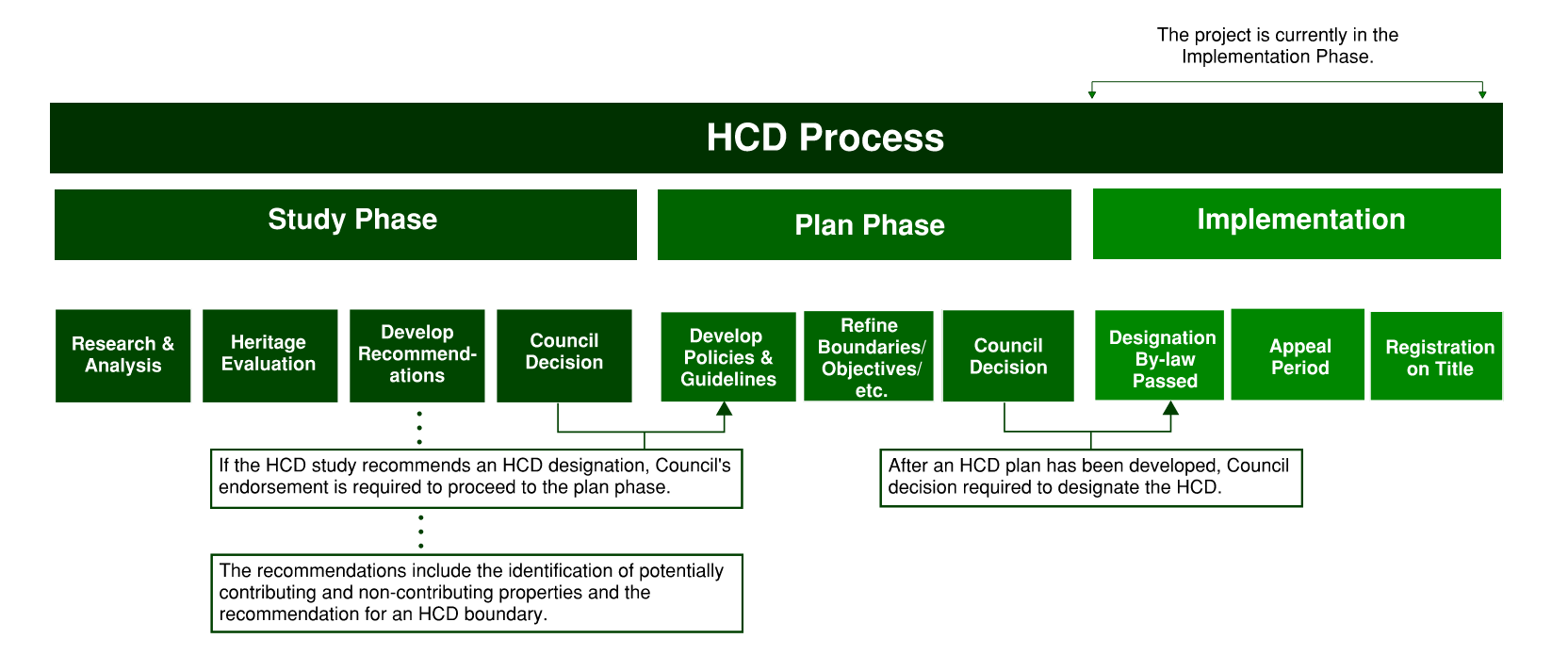
The goals of the first phase are outlined in Section 40 (2) of Part V of the OHA:
Scope of study: (2) A study under subsection (1) shall,
- a. examine the character and appearance of the area that is the subject of the study, including buildings, structures and other property features of the area, to determine if the area should be preserved as a heritage conservation district;
- b. examine and make recommendations as to the geographic boundaries of the area to be designated;
- c. consider and make recommendations as to the objectives of the designation and the content of the heritage conservation district plan required under section 41.1; and
- d. make recommendations as to any changes that will be required to the municipality’s official plan and to any municipal by-laws, including any zoning by-laws. 2005, c.6. s.29.
The Study Phase concluded on June 25, 2025 with Council receipt and endorsement of the Study Report, and direction to begin Phase 2 - The Plan Phase. You can read the Study Report for more details.
The scope of the second phase of a heritage conservation district plan is outlined in Section 41.1 (5) of the OHA.
The plan must include:
- a statement of objectives to be achieved in designating the area as a district;
- a statement explaining the cultural heritage value or interest of the district;
- a description of the heritage attributes of the district and of properties within it;
- policy statements, guidelines, and procedures for achieving the objectives and managing change; and
- a description of alterations that may be carried out without a heritage permit.
You can read the Plan Report for more details.
About Heritage Conservation Districts
An HCD is an area of cultural heritage in a town that is defined by clear boundaries. It may include buildings of interest as well as features like trees, landscapes, and streetscapes.
An HCD is protected by municipal by-laws passed by Council under Part V of the Ontario Heritage Act. The intent is to protect a community’s heritage and manage change.
Heritage district designation ensures that renovations, additions, and future developments complement the district's character. An HCD can be an effective means to prevent the demolition of significant heritage buildings. It can also ensure that renovations or new construction projects in the district are consistent with design guidelines so that they are in keeping with the heritage character of the district.
Properties designated under Part IV of the Ontario Heritage Act have individual by-laws outlining a statement of significance, the cultural heritage value or interest, and a list of attributes.
Properties designated under Part V of the Ontario Heritage Act are identified as contributing to a geographical area's cultural heritage value or interest. These properties are located within a Heritage Conservation District, which has a Plan and By-law for the entire geographical area within a defined boundary.
Properties designated under Part IV of the OHA can be located within a Heritage Conservation District, and individual by-laws are upheld alongside the HCD Plan and By-law.
Yes. Designated Heritage Conservation Districts are a form of recognition of an area which can have beneficial impacts. Properties within an HCD are eligible for the Town's annual Designated Property Grant Program, which offers 50% matching grants to a maximum of $7,500.00 for small to medium-sized maintenance and restoration projects. More information can be found at https://www.notl.com/heritage-planning. The Town is also considering establishing a Heritage Tax Rebate Program for designated commercial and industrial properties.
Other benefits include:
- Encouraging better design for new construction
- Enhancing Niagara-on-the-Lake’s identity, pride, and sense of community
- Property values generally benefit from HCD designation based on Canadian studies
- Enhancing cultural tourism by protecting a unique cultural identity and leveraging the area's history and character to bolster economic growth
- Promoting community awareness of the Town’s history
- Providing a process to ensure that property changes respect the community’s heritage value and are appropriately managed
- Preserving Ontario’s heritage for the enjoyment of generations to come
- Providing advice to property owners on building conservation and maintenance
Change within an HCD is possible and is guided by policies and guidelines in an HCD Plan. The HCD Plan policies and guidelines are meant to conserve the cultural heritage value of the HCD by guiding how change may be compatible with that value and preserve what makes the HCD special.
HCD Plans explain the types of alterations (i.e. changes) that require a Heritage Permit and those that do not. Municipalities define the Heritage Permit process. Some allow permits for minor changes to be approved by Staff, whereas the permitting of major changes may go through a full approval process. Some examples of minor alterations include painting, minor repairs, interior alterations, and those which aren't visible from the street.
A Heritage Conservation District (HCD) designation applies to the exterior of buildings and the surrounding property. Properties within a HCD are classified either as Contributing Properties or Non-Contributing Properties:
- Contributing Properties are directly related to the significance of the HCD. Contributing properties include older buildings of historic interest.
- Non-Contributing Properties: Properties that are not related to the reasons the HCD has significance. This could be a result of the age, the architectural style, the history, and the integrity.
Contributing Properties and Non-Contributing Properties have different policies regarding exterior work, such as alterations, additions, demolition, or new construction. Policies for Contributing Properties tend to focus on protecting the elements of the property that are related to the significance of HCD. Policies for Non-Contributing Properties usually focus on guiding design so that they are compatible with the character of the HCD. These policies ensure that the character of the district is enduring and that the cultural value of the area remains intact or is enhanced by the work being completed. A Heritage Permit is needed to complete most exterior work in the HCD.
An HCD designates all properties within its boundaries under the Ontario Heritage Act.
The HCD Plan identifies which properties are considered "contributing" to the heritage character of the district, and properties which are considered "non-contributing". The HCD Plan would provide a different set of policies for each type of property. The purpose of designating non-contributing properties is to ensure that changes to these properties are sensitive to the identified character of the area and do not have an adverse impact on the reasons the area is identified as an HCD.
Yes. Changes located on the exterior of the building must conform to the policies of the HCD Plan. This applies to both contributing and non-contributing properties. The goal of an HCD is not to prohibit change but to manage change in a way that maintains the area's character.
No. It is not considered best practice to make any new construction look like authentic heritage buildings. However, it is considered best practice to make new construction compatible with heritage buildings so that it complements or enhances the area's existing character. This may include paying attention to building proportions, patterns of window/door openings, setbacks, and materials.
No, a designation within an HCD does not affect the property's use. The Official Plan and Zoning By-law governs land use. If a property owner would like to change the use of a property, an application for an amendment to the Official Plan and/or Zoning By-law may be required. If a change of use requires alterations to the building, the alterations may require heritage permit approval under the Ontario Heritage Act.
Property values are determined by many factors. Studies indicate that property values are most often similar or higher in Heritage Conservation Districts when compared to similar properties in undesignated areas. For more information, please read the following articles:
- "Heritage Districts Work! – More Stories of Success", 2012. Architectural Conservancy of Ontario, Robert Shipley, University of Waterloo
- "The Economic Value of Heritage Districts: How Assessment Growth in Heritage Conservation Districts Compares With Non-designated Areas in Hamilton", 2016. Urban Insights bulletin, CivicPlan.
The provincial Ministry of Tourism, Culture and Sport and the Insurance Bureau of Canada have both confirmed that insurance premiums should not go up as a result of heritage designation. Heritage property owners are encouraged to shop around to find the right insurance provider and should contact the Insurance Bureau of Canada if their insurer has questions regarding designation.
About the HCD Study
An HCD is created by Council through municipal by-laws under Part V of the Ontario Heritage Act following a recommendation from an HCD Study. During the HCD Study phase, research and analysis will identify periods of significance in the town's evolution, propose a statement of significance based on criteria, identify the buildings and features that contribute to the significance, and propose a boundary.
The process of designating and protecting Heritage Conservation Districts (HCD) is completed in two phases: an HCD Study and then an HCD Plan. The Town of Niagara-on-the-Lake hired a consultant, Cultural Spaces, to carry out the HCD Study and, should it be approved by Council, the HCD Plan.
The HCD Study is a comprehensive review aimed at updating the existing Heritage Conservation District Plan and assessing the possibility of expanding the district boundaries. This ensures heritage policies align with modern standards while protecting Niagara-on-the-Lake’s historic character.
The study is part of the Town’s commitment to heritage conservation, as outlined in Council’s 2022-2027 Strategic Plan. It helps manage change in Old Town while ensuring its historic character is preserved for future generations.
Community engagement is a key part of the development of the plan. Residents and property owners will have opportunities to provide feedback on the proposed HCD boundaries in Phase 1 of the Study and on the proposed policies before the final updated HCD Plan is presented to Council.
The Town will provide regular updates through:
• Notices in local newspapers
• Social media announcements on Town platforms
• Direct correspondence to property owners within the Study Area.
• Community engagement opportunities
About the Study Area By-law
On February 25, 2025, Town Council approved the Study Area By-law that comes into effect on March 27, 2025, and:
- Identifies the boundaries of the Study Area
- Implements a temporary one-year pause on certain exterior property alterations within the Study Area
- Temporarily pauses changes that could compromise heritage character before the HCD Plan can be updated.
The Study Area is not the final geographic area of the updated HCD. At the end of Phase 1, a Study report recommended a new boundary for the HCD which was endorsed by Council on June 24, 2025.
A notice was published in local newspapers, a news release was shared on the Town's website and social media channels, and the notice was mailed directly to all property owners within the Study Area. Within 30 days of notice in local newspapers, property owners may appeal the By-law to the Ontario Land Tribunal.
The temporary pause does not apply to all property changes. Minor alterations are exempt from the By-law and may proceed during the 1-year period, including:
- Interior renovations and repairs
- Construction of new legally conforming accessory buildings (e.g., sheds, garages)
- Temporary event structures
- Previously approved development projects
- Emergency repairs
If you are unsure if the Study Area By-law restricts your proposed property alteration, please contact Heritage Planning Staff at heritage@notl.com.
Engagement Opportunities
A significant component of this HCD Study is the emphasis on engagement with local heritage experts, advocates, and researchers.
This commitment to consultation was first demonstrated with the Working Group and the twenty-four hours of walking tours, data collection, and additional feedback that launched the HCD Study with NOTL’s engaged heritage community represented at the outset of this project.
To mitigate overall costs, and in recognition of the sheer volume of properties to be reviewed, Heritage Staff are seeking volunteers from the Municipal Heritage Committee (“MHC”) to establish the HCD Study Working Group. The “Working Group” will be tasked with conducting fieldwork to complete Built Heritage Survey Forms for properties within Old Town that may be considered for inclusion in the updated HCD Plan.
Under Part V of the Ontario Heritage Act, subsections 40 and 41 outline the process by which a HCD study and Plan must proceed, including consultation with the Town’s MHC, property owners, and community. Upcoming work for the HCD Study will include presentations to the MHC, and community engagement sessions; however, this engagement typically occurs later in the study process. As a result of the HCD Working Groups, the HCD Study will benefit from this early engagement with the MHC and local heritage enthusiasts, each with an interest in the celebration and preservation of Old Town’s historical character, as the starting point of the project. Further, lines of communication have been opened to allow for these volunteers to continue to contribute meaningfully to the HCD Study process.
According to Section 40 (3) of the OHA: If the council of a municipality has established a municipal heritage committee under section 28, the council shall consult with the committee with respect to the study.
Members of the Cultural Spaces Team attended the January 8, 2025 MHC meeting to respond to comments on a Staff Report updating the Committee on the HCD Study's progress.
Information about past and future MHC meetings can be found on the Town's Meetings, Agendas & Minutes Page
The HCD Study is currently in Phase 2.
The scope of the second phase of a heritage conservation district plan is outlined in Section 41.1 (5) of the OHA.
The plan must include:
- a statement of objectives to be achieved in designating the area as a district;
- a statement explaining the cultural heritage value or interest of the district;
- a description of the heritage attributes of the district and of properties within it;
- policy statements, guidelines, and procedures for achieving the objectives and managing change; and
- a description of alterations that may be carried out without a heritage permit.
You can read the Plan Report for more details.
The HCD Study is currently in Phase 2.
Information about Phase 2 Consultation will be updated when available.
In accordance with Section 41.1 (6) of the OHA, Consultation is required prior to the adoption of the HCD Plan By-law:
(6) Before a by-law adopting a heritage conservation district plan is made by the council of a municipality under subsection 41 (1) or under subsection (2), the council shall ensure that,
- (a) information relating to the proposed heritage conservation district plan, including a copy of the plan, is made available to the public;
- (b) at least one public meeting is held with respect to the proposed heritage conservation district plan; and
- (c) if the council of the municipality has established a municipal heritage committee under section 28, the committee is consulted with respect to the proposed heritage conservation district plan. 2005, c. 6, s. 31.
Information about Public Meetings, including the time and opportunities to provide feedback (oral or written) will be posted to this page when available, in accordance with Section 41.1 (7-11).
The Town now invites residents to a Public Meeting for the HCD Plan:
- Date: Tuesday, January 13, 2026
- Time: 6:00 pm
- Location: Town Hall, 1593 Four Mile Creek Road
- Registration: Required with Clerks, deadline for registration is before 12 p.m. on January 13, 2026
See the Official Town Notice of Public Meeting for more information.
Read the Phase 2: Plan Report from the Town's consultants, Cultural Spaces.
Property Owner FAQs
A Heritage Conservation District (HCD) is a tool used by municipalities to guide and manage change within an area identified for having strong heritage value. The HCD will provide protection to properties including demolition restrictions, through the Ontario Heritage Act.
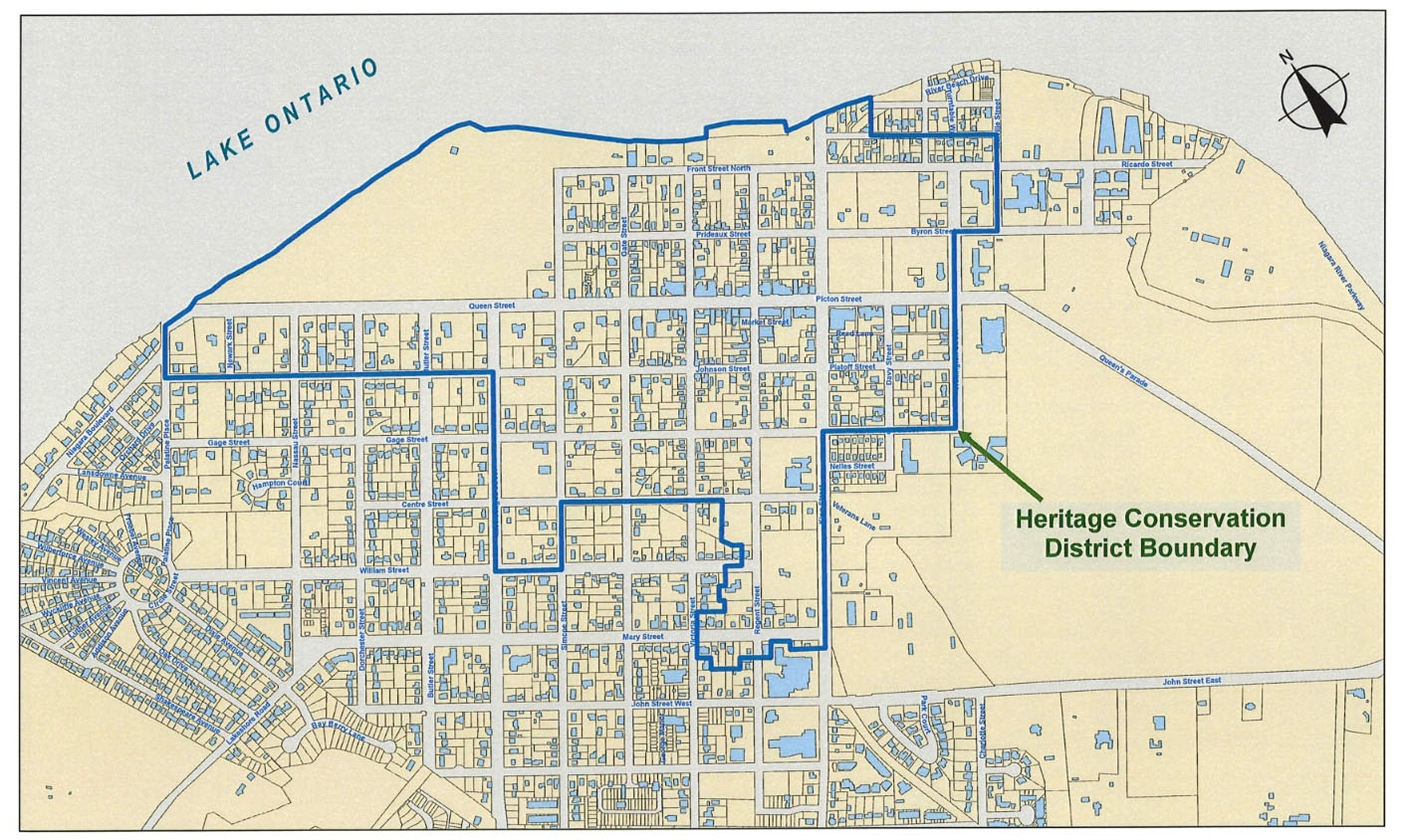
To determine if your property is located within the approved HCD boundary and applicable Plan please view the boundary map below.
Image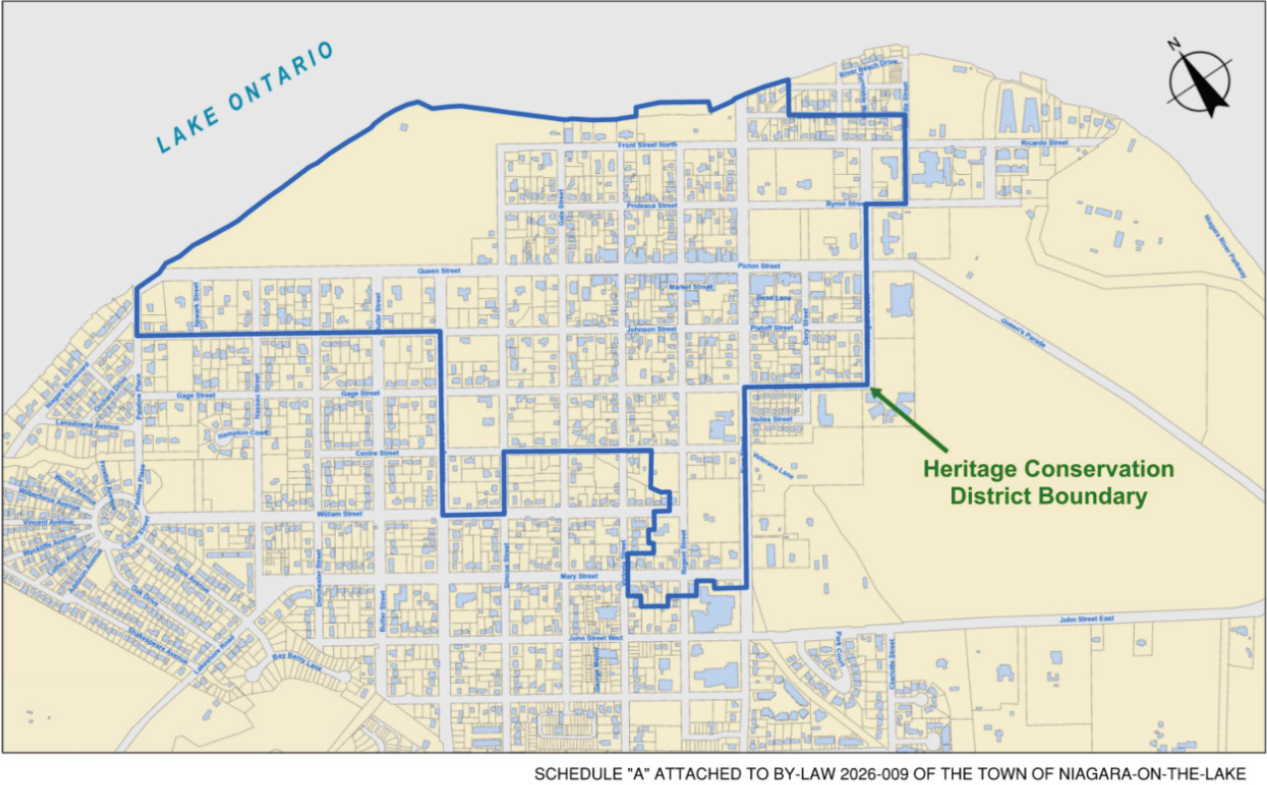
As a property owner within the HCD, you will be required to comply with policies and guidelines if you want to make changes to your property outside of routine maintenance. These policies and guidelines are in place to ensure changes in the area respect the historic character of the HCD.
Notice of the passage of By-law 2026-009 was published in local newspapers on March 12, 2026, and the 30-day appeal period will be initiated. If no appeals are received by April 11, 2026, the by-law comes into force following the conclusion of the appeal period. If any appeals are received, the by-law will come into force when all appeals have either been withdrawn, dismissed or resolved by the Ontario Land Tribunal (OLT).
Until By-law 2026-009 comes into force and effect, the existing heritage conservation district continues to apply within the current (1986) district boundary.
Properties within the HCD have been classified into two categories. Both categories are subject to policies and guidelines that guide and manage change while preserving the Towns’ historic character.
Contributing Property: A property, structure, landscape element or feature within a Heritage Conservation District that supports the cultural heritage value of the District.
Buildings that have been identified as Contributing to the heritage character of the District include those that:
- Were constructed during the District’s periods of significance, including:
- Rebuilding (c. 1814 – c. 1829)
- Growth (c. 1830 – c. 1859)
- Prosperity (c. 1860 – c. 1914)
- Are an example of a prevailing architectural style during these periods of significance such as Georgian, Neoclassical, Ontario Cottage, Regency Cottage, Classic Revival, Picturesque, Italianate, Second Empire, Queen Anne Revival, Edwardian, and Colonial Revival
- Maintain their integrity and/or has contextual value as part of an ensemble of historic buildings
Non-Contributing Property: A property, structure, landscape element or feature within a Heritage Conservation District that does not support the overall cultural heritage values, heritage attributes, and integrity of the District.
Alterations to Non-Contributing properties and new construction can both impact the cultural heritage value of the District and provide opportunities to enhance the district. To manage this change, property owners may be required to apply for a Heritage Permit. Town heritage staff are available to assist with this process to ensure ease of application for property owners.
To confirm a property’s classification, please refer to Appendix E (page 124) and Appendix G (page 385) of the Plan.
Major exterior changes, additions, demolitions, and new construction require heritage review and a heritage permit for both contributing and non-contributing properties. The Plan provides guidelines to help ensure changes are compatible with the District.
Policies and guidelines for contributing properties are outlined in Section 6 of the Plan, beginning on page 64.
Policies and guidelines for non-contributing properties are outlined in Section 7 of the Plan, beginning on page 82.
In summary; maintenance is encouraged and typically does not require heritage permit approval. Maintenance is considered the repair of existing materials, with in-kind materials, repainting of the same colour, replacement of roofs with the same style and landscaping that does not require excavation or grade changes.
A complete list of exempt maintenance works can be found on page 99, Section 9.1 for contributing properties, and page 101, Section 9.2 for non-contributing properties
If you’re unsure, contact Staff before starting work.
Interior work does not require a heritage permit unless it is connected to an exterior change or other regulated activity. The HCD Plan focuses on changes visible from the public realm and those affecting heritage attributes.
Redevelopment isn’t automatically prohibited, but it will be evaluated through the heritage framework to ensure new construction and changes respect the District’s character and heritage attributes. The demolition of contributing properties is highly discouraged within the Plan.
In some cases, yes. Depending on the project, you may need planning approvals (such as zoning review, minor variance, site plan) in addition to heritage review. Each application is unique. When considering a project, contact staff early in the process to discuss what applies to your specific proposal.
Council retains authority for complex or sensitive applications, with the Municipal Heritage Committee serving as an advisory body. Some approvals may be delegated to Staff in accordance with Town by-laws and procedures, to expedite the wait times for property owners.
Once an application is deemed complete, the Town has 90 days to make a decision. While timelines vary depending on the complexity of the request and completeness of the submission, Town staff aim to bring applications forward to the next available meeting of the Heritage Committee and Council. A decision is typically made within six weeks.
If you believe details about your property are incorrect, you can contact Town Staff with supporting information (e.g., documentation on construction date or past approvals) for review.
Contact Heritage Planning Staff at heritage@notl.com before starting work. Early conversations can help confirm requirements and avoid delays. Staff are available to assist you through the process.